
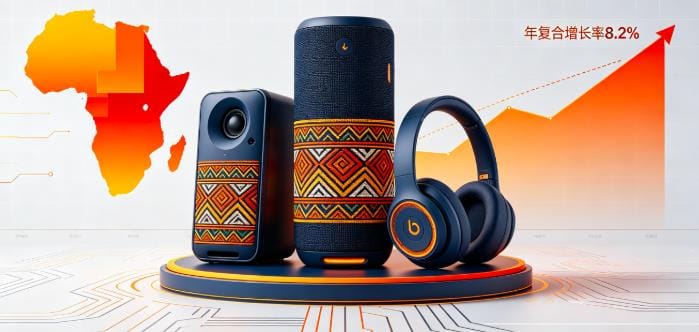
New industry research shows Africa’s audio market is growing steadily in 2025, fueled by wireless adoption, localized demand upgrades, urbanization, and a young population dividend. Chinese brands dominate with cost-effectiveness and regional adaptability, while the market follows a differentiated pattern: “South Africa leads, Nigeria grows fast, and East Africa unlocks potential.” Over the next five years, the continent’s audio sector will undergo three major transformations—”intelligent leapfrogging, scenario-based segmentation, and brand upgrading”—emerging as a key growth engine for the global audio industry.
I. Market Size: Steady Expansion with Regional Gradient Growth
In 2025, Africa’s total audio market (including home, portable, car, and professional audio) surpasses USD 56 billion, with a 5-year CAGR of 4.8%-5.5% and accounting for ~3.2% of the global market. Regional performance varies significantly:
- South Africa: Mature market, 38.1% of the continent’s total (USD 21.3 billion in 2025), with strong demand for premium audio and smart home audio devices;
- Nigeria: Africa’s most populous nation, 27.4% market share, growing over 5.8% in 2025—one of Africa’s fastest-growing core markets;
- East Africa (Kenya, Tanzania, Uganda): Explosive demand for portable Bluetooth speakers and solar-powered audio, regional growth exceeding 6.5% in 2025, with rapid penetration in rural areas;
- North Africa (Egypt, Morocco): Rising demand for home theaters and soundbars. The MEA soundbar market hits USD 6.3 billion in 2025, with Africa contributing over 40%.
Future Forecast (2026-2030):
- Overall market CAGR will rise to 6.8%-7.5%, reaching USD 85 billion by 2030;
- East and West Africa’s rural markets will lead growth (CAGR >8%);
- North Africa’s home entertainment audio market will double in size;
- Professional audio will be the fastest-growing segment (CAGR 9.2%).
II. Product Structure: Wireless & Portable Dominate, Local Adaptation Is Key
In 2025, Africa’s audio market shifts toward wireless, portable, low-power, and heavy-bass products, while traditional wired audio continues to decline:
- Portable Bluetooth Speakers: 60%+ of total sales, priced USD 20-100. Africans prefer models with strong bass, long battery life (8-24 hours), and water/dust resistance for outdoor gatherings and community events;
- Wireless Headphones/Earbuds: Fastest-growing category (+7% YoY in 2025), popular among 15-35-year-olds for music and online entertainment;
- Soundbars: Core of home entertainment upgrades (+5.2% YoY in 2025), with rising penetration in urban households in South Africa and Nigeria (led by LG, Hisense);
- Solar-Powered Audio: Must-have for rural areas (unstable electricity), sales up 15% YoY in East/West Africa’s rural regions—Chinese brands hold >90% market share;
- Professional Audio (Stage/Commercial): Steady growth with entertainment industry recovery, concentrated demand in South Africa and Nigeria (competition between JBL/Bose and Chinese professional brands).
Future Forecast (2026-2030): Product evolution will follow “3 Upgrades + 2 Emerging Trends”:
- Tech Upgrade: Bluetooth 6.0 and Wi-Fi 6 will prevail; AI voice assistants (supporting Swahili, Hausa, and other local languages) will reach 45% penetration by 2030;
- Function Upgrade: Solar+storage integrated audio will grow from 12% (2025) to 30% (2030); fast charging (8-hour use from 30-minute charge) and reverse wireless charging will become standard;
- Scenario Upgrade: Scene-specific products (camping audio, car rear-seat entertainment, mini commercial speakers) will grow at CAGR >10%;
- Emerging Categories:
- Bone conduction/open-ear headphones (adapted to Africa’s hot climate and sports) – CAGR 18%;
- Smart speakers linked to home ecosystems – will penetrate urban South Africa/Nigeria, reaching USD 5 billion by 2030.
III. Competitive Landscape: Chinese Brands Lead Mid-Low, Internationals Dominate Premium
In 2025, the market follows a “Chinese dominance in mid-low segment, international leadership in premium, local brands as supplements” pattern:
- Chinese Brands: 78% market share, leading mid-low segment (USD ) with brands like EDIFIER, Skyworth, Hisense, Xiaomi, and Tecno. Strengths: cost-effectiveness, bass optimization, mature solar tech, and fast local iteration. Channels cover wholesale, e-commerce, and offline chains;
- International Brands: 15% market share, dominating premium segment (USD >200) with JBL, Bose, Sony, LG, and Samsung. Focus: sound quality, brand premium, and smart ecosystem integration. Core presence in high-end retail in South Africa/Nigeria’s cities;
- Local Brands: 7% market share, regional small brands offering low-cost basic models and local after-sales. Mainly cover rural and underserved markets.
Future Forecast (2026-2030):
- Chinese Brands: Top players will upgrade to premium via local factories/R&D; their premium segment share will rise from 8% (2025) to 25% (2030). Market CR5 will increase from 42% to 65%;
- International Brands: Will partner locally (telcos, e-commerce) to launch mid-range products (USD 100-200) for urban middle class;
- Local Brands: Will expand to 10% market share by 2030, focusing on West/Central Africa’s rural markets with niche scenes and local after-sales.
IV. Key Drivers: Culture, Demographics, Channels & Tech Adaptation
- Cultural Necessity: Music is integral to daily life—Africans prioritize heavy bass for family/community gatherings;
- Demographic Dividend: 60% of Africa’s population is 15-35 years old—young people drive demand for wireless audio;
- Urbanization: 45% urbanization rate in 2025—growing middle class boosts demand for home theaters and premium speakers;
- Channel Diversification:
- Offline: Wholesale markets (e.g., Luthuli Avenue, Nairobi), small electronics shops, and street vendors (Chinese brands excel in wholesale);
- Online: Local e-commerce (Jumia, Konga) grows fast—25% of audio sales are online in 2025 (young consumers prefer online comparison/shopping);
- Tech Adaptation: Solar power, low energy consumption, and 110-220V wide voltage solve Africa’s electricity challenges.
Future Drivers:
- Digitalization: Africa’s internet penetration will reach 60% by 2030—short videos/live streaming will push online audio sales to 40%;
- Policy Benefits: AfCFTA tariff reductions and subsidies for new energy products (e.g., solar audio) will lower costs and stimulate rural demand.
V. Challenges & Future Trends (2026-2030)
Key Challenges
- Economic inequality: Limited purchasing power in parts of West/Central Africa fuels fierce low-cost competition;
- Counterfeit products: Fake Chinese brands disrupt the low-end market;
- Logistics/after-sales gaps: High logistics costs and poor after-sales in remote areas hurt user experience;
- Tariff barriers: High import duties in some countries squeeze profit margins;
- Tech iteration pressure: Consumers demand smarter, multi-functional products—brands need continuous R&D.
Core Future Trends
- Deep Intelligence: AI voice interaction and smart home integration will be standard for mid-premium products; smart audio will account for 35% of the market by 2030;
- Localization 2.0: Brands will build local assembly plants, R&D centers, and after-sales networks—adapting to local electricity, climate, and languages;
- Green Transition: New energy audio (solar, hydrogen) will reach 30% of sales by 2030; eco-friendly materials (recycled plastic, bamboo fiber) will be key differentiators;
- Channel Innovation: “Offline experience + online live streaming + local warehousing” will prevail. Brands will partner with telcos/oil companies for “bundle sales” (e.g., free audio with phone plans);
- Professional Audio Boom: Music festivals, sports events, and commercial real estate will drive demand—professional audio market will hit USD 12 billion by 2030 (Chinese brands to capture >20%);
- Brand-Centric Competition: Low-cost rivalry will fade—brands will build barriers via patents, design, and cultural marketing (e.g., collaborations with local musicians).
VI. Conclusion: Africa Is a Core Overseas Market for Chinese Audio Brands
In 2025, Africa’s audio market thrives on cultural demand, demographics, and urbanization—wireless portable products lead, and localization is key. Over the next five years, intelligent, green, and localized trends will drive quality growth. Chinese brands, already dominant with cost-effectiveness and adaptability, will further expand their premium share via tech innovation, brand upgrading, and full-chain localization.
About This Report
Based on field research, channel interviews, and data analysis across 12 core African countries (South Africa, Nigeria, Kenya, Tanzania, Uganda, Egypt, Morocco, etc.), covering 30+ major brands and 200+ key distributors. Data is verified for industry reference only.